
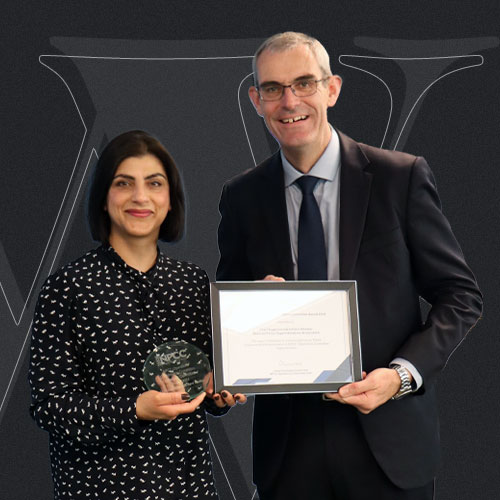
Ch Supt Harvi Khatkar
Tell me about yourself, who is Harvi & what factors have influenced your identity?
I have always been driven and that comes from my family upbringing where the ethos of hard work, fairness, honesty and humility have been instilled in me. As a child I watched my parents deal with racism and mobilise a community to address the issue, despite at that time hate crime was not an offence. It taught me to stand up and fight for what’s right. As the youngest of 4 siblings, I have always pushed boundaries, which at times I am sure my parents didn’t always appreciate, but I know how proud they are of me and what I have achieved. I feel very lucky to have the support of all my family.
I have always had an interest in learning new skills, knowledge and experience. I joined policing with a degree, having studied part time whilst working full time. In 2012, I completed an MBA, with the Open University and had the support of my force. I was selected for the Cropwood Fellowship at Cambridge University and whilst supporting the College of Policing as an associate I completed an NVQ level 3 in education. Throughout my career, I have proactively sought new opportunities and have not been afraid to take on new challenges and have found the use of both mentors and coaches invaluable.
My values drive me and despite setbacks, I have learned to become more resilient, be kinder to myself and to keep going. My mantra is ‘don’t allow others to stop you reaching your potential’. The journey may not always be straightforward, and it may take a little longer but staying true to your values is fundamental. When I am asked to share my personal journey with colleagues, I always find this a humbling experience and to learn it has inspired others is a great feeling.
I love to travel and cook and have been fortunate to visit some amazing places and experience different cultures. Some of the places I have visited include Argentina, Brazil, Singapore, Australia, Alaska, Kenya, India and South Africa. Whilst not a thrill seeker I have tried some extreme sports such as parasailing, paragliding, jet skiing and ocean floor walking in the Great Barrier Reef. Although, I am probably more cautious now as I get older.
#freeToBeMe: What does this mean to you and have you felt free to be your true self during your policing career?
I think this can mean different things to different people and no one should be judged. I believe everyone should feel that they have a voice and are heard, even if this means at times you must listen to uncomfortable truths. I believe everyone should be able to come to work and not be judged for what they look like, their background, heritage, social status or whether they choose to be private or public about their personal lives. Diversity in all its forms should be celebrated and not feared.
For me this is about how true I have remained to my values, which are core to everything I do. I am proud to say that I have stayed true to my values, even if at times this has tested my resilience. I have learned over time and with experience that there are different ways in which you can raise issues, and this has been about knowing when and how and along the journey building allies who can support you.
I have had feelings of imposter syndrome, for example when going into new roles and at key events but I have learned that it is ok to feel this way, and not let it prevent you from being the best you can. I have heard many senior leaders talk about this and for me this is about authentic leadership and knowing who you are and what your strengths and areas of development areas are, as we all have them. You are not expected to know everything and having the support of subject matter experts is key.
Yes, there have been times when I have learned to adapt to new policing environments and for me this is more about understanding the political landscape in which I am operating in, than changing who I am and what I stand for. However, this does not mean I have compromised my values.
Biggest Achievements in Policing?
On a personal level I am proud that I have broken so many glass ceilings. In my own force of West Midlands, I was the first woman of colour to reach both Superintendent / Chief Superintendent and be the first Tactical Firearms / Public Order Commander. I am pleased to see other female colleagues succeed. I was the first person of colour to be elected as the Vice President of the Police Superintendents Association, in its history. Being the first sometimes does come with additional pressure but it shouldn’t, and no one should feel they need to prove themselves to be better than their colleagues because of their gender or ethnicity or any other protected characteristic. What it taught me was the importance of role modelling.
On a professional level I have been fortunate to have led on Home Office funded projects in relation to hate crime and tackling domestic abuse affecting Asian communities. The former led to changes in the force hate crime policy as well as how the Crown Prosecution Service and Local Authority identified and dealt with hate crime. The latter was a pioneering project in force at the time and working with an outreach programme we delivered joint domestic abuse training to officers, which positively changed the perception of how officers saw victims of south Asian heritage.
As Vice President of the Police Superintendents Association (PSA), I led on year 2 of the Future Supers programme, which supported colleagues from underrepresented groups and successfully negotiated with the College of Policing to take ownership of the programme. It continues to grow under the College’s leadership. As a result of various listening circles, I led on with colleagues from underrepresented groups, together with results from a member’s survey, which I instigated, the association was able to provide evidence to the College of Policing to inform their review of the Executive Leadership Programme for Chief Officers, to improve diversity. During my tenure DEI was a priority and for the first time I ensured it featured as the opening session on day 1 of the PSA 2023 conference. I was privileged to be asked to provide evidence to the Home Affairs Select Committee in 2023, it was 2 days after the horrific case of David Carrick, and I was asked how we can improve the culture within policing and tackle misogyny.
Biggest barriers you have faced?
Overall, I am pleased to say that I have worked for many great leaders over the years who have supported me throughout my career and helped me achieve my aspirations. However, I have faced both race and sex discrimination, internally and externally. Externally, having grown up facing racism, you learn to become more resilient to the name calling and ignorant behaviour of the minority. Whilst I don’t wish to dismiss or excuse this behaviour, it is “water off a ducks back”. My gender and ethnicity define me and whilst, I am optimistic, I can never say that I will not experience this in the future. This is a societal issue that needs better education and awareness. I have taken opportunities working with community groups, for example to educate colleagues to understand the cultural impact of domestic abuse affecting Asian women, which led to increased reporting and outcomes for victims. As lead for a stop and search scrutiny panel, I combined training for officers with sessions involving members of the public, so officers could hear first-hand the experience of communities during stop and search encounters. I received formal recognition for my work in these areas.
However, having to deal with these issues from colleagues, is unacceptable and takes courage and resilience to address the issues. This behaviour has no place in policing and my values will always guide me towards being the ‘Upstander’ and calling out this behaviour. As a senior leader this is so important, as we set the standards. This can be a very lonely place at times but absolutely the right thing to do. It is important to build allies who can support you. The service needs to do more to support ‘Upstanders’, by creating safe spaces for colleagues to talk openly and we need to get more comfortable at listening to uncomfortable truths. Upstanders and those who experience discrimination should not be made to feel like organisational terrorists. We need to make sure they have the appropriate support and that we learn lessons, so as a service we continually grow and strive to create a fair and inclusive culture.
What can policing do better to support women of colour in the service?
The number of female chief officers from an ethnic minority background stands at single figures. There has been no female chief constable from an ethnic minority background. In September 2023, there were 4 female Chief Superintendents and 10 Superintendents from an ethnic minority background, this includes those that are temporary. I am the highest-ranking female of colour in my own force. The figures speak for themselves. Diverse representation at all ranks must be a priority for Policing, if it is to change the culture and become more inclusive.
In my experience, most women will have faced some form of challenge during their career, however, those challenges are compounded when you have additional protected characteristics. It is only by looking at the issues through the lens of women of colour, that you can fully understand and appreciate the issues. We must create safe spaces for colleagues to have difficult conversations. Their voices need to be continually heard and change needs to happen. This can be achieved using a variety of methods and by engaging with staff networks across all areas. This will ensure issues of intersectionality are identified and where there are common themes, these are addressed collectively and not in silos, so progress takes place at pace. The test of successful initiatives is to ask colleagues what has changed for the better? Do colleagues feel they have equal opportunities? What are the measures of success?
We need to ensure consistency of data collection in areas of recruitment, retention, progression (i.e., for promotion and lateral development) talent management and misconduct. The data should be used for benchmarking, identifying trends, areas of disproportionality and used to inform and implement change. To continue to build trust and confidence in policing, the data should be publicly available and have Home Office oversight.
The College of Policing’s ASPIRE programme is excellent and supports colleagues from underrepresented groups and I believe funding should be made available to make it accessible for all ranks from underrepresented groups. I welcome the future implementation of the College of Policing’s Talent Programme. Strategic workforce plans need to ensure working conditions and internal culture meets the demand of both the current and future workforce, so we are not having the same conversation about representation in another 10 years’ time.